


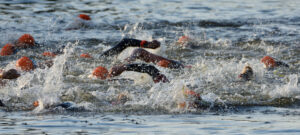
Are you ready to swim a mile with a 1,000 of your closest friends?
Every summer, triathletes show up at my pool in full-blown panic. They’ve started triathlon swim training and signed up for their first race months ago, but as race day gets closer, they realize: “I don’t think I can finish the swim.”
My heart goes out to them. I’ll do everything I can to help them get through the race — but just surviving the swim isn’t the goal. Making yourself miserable for half an hour, gasping for breath, and praying for the exit isn’t why you signed up for a triathlon.
The good news? With the right approach, the swim can become a strength instead of a liability. Over the past 25 years of coaching, I’ve learned some truths about triathlon swim training that can save you time, stress, and frustration. And I’ve distilled them into a five-step process that can turn the swim from something you dread into something you look forward to.
Three Hard Truths About Triathlon Swim Training
- Your run and bike fitness don’t translate.
You may be able to bike 40k or run 10k, but swimming 1.5k is a completely different sport. Water is far more resistant than air. The breathing pattern is unnatural. The muscle groups you rely on for running and cycling don’t carry over. You have to respect swimming as its own discipline. - Efficiency comes before endurance.
If your stroke is inefficient, the water will punish you. Fighting for another lap just makes you better at struggling. The only way forward is to invest in technique first. Once you’re moving smoothly, then endurance training pays off. - Open water is not the pool.
Pool fitness doesn’t automatically prepare you for open water. No lane lines, no walls, cold water, currents, waves, sun glare — and hundreds of other athletes crashing into you. To succeed, you need specific open-water skills on top of your pool training.
The Five Steps to Becoming Triathlon-Ready
Step 1: Master a Freestyle Drill System
Swimming is a technique-limited sport. Unless you raced at the collegiate level, you have room to get faster by swimming smarter. A proven drill system should develop:
- Balance and streamline
- Arm timing with body rotation
- Relaxed arm recovery
- Breathing mechanics and rhythm
- Propulsion from arms, legs, and hips
Don’t rush this phase. Drills aren’t “warm-ups” — they are the building blocks of your stroke. Master them patiently and you’ll see exponential returns.
If you are swimming in the Chicago Blue Dolphins programs, our Freestyle 1 and Freestyle 2 classes will give you this full set of stroke drills.
Step 2: Repeat Efficient Freestyle in the Pool
Once drills click, start blending them into full-stroke swimming. Measure efficiency with stroke count — how many strokes it takes to cross the pool. Your target is your “Green Zone,” the efficient range for your height.
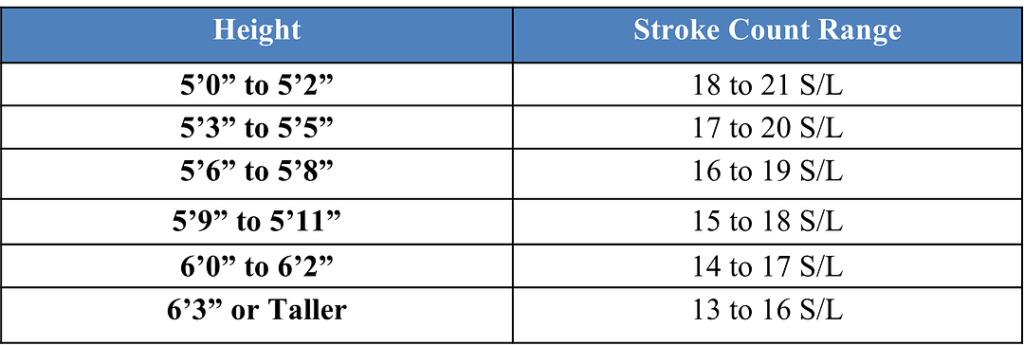
If you swim in a 25 meter pool, the numbers will be 1-2 stroke more. If you swim in a 50-meter pool, double the numbers and add 10% as a rough guide.
You’ll want to keep working on the drills and easy swimming until you an regularly swim in this range without breaking rhythm. If you’re count is higher than this range, you are spending more time fighting the water than you are swimming through it.
The benchmark: swim a simple ladder set (25 + 50 + 75 + 100 yards) while keeping your stroke count in your Green Zone. If you can do that, you’ve built an efficient, functional freestyle stroke.
Step 3: Build Base Conditioning Without Losing Technique
Now extend your efficient stroke over time. Aim for a continuous 15-minute swim covering at least 400 yards, while keeping your stroke count in the Green Zone. That pace (about 3:45 per 100 yards) puts you safely under most triathlon swim cutoffs.
At this point, you’re no longer “learning to swim” — you’re training like a swimmer. Your practices will look like the practices you see online. You’ve still got a lot of work to do, but you are in the right lane.
Step 4: Train Like a Triathlete
With skills and fitness in place, commit to a triathlon-specific swim program. For a sprint triathlon, plan 12–16 weeks of structured training. Longer race distances will have longer plans. This type of training will get you comfortable swimming your race distance and improve your 100-yard swim pace.
This is where you develop pace control, endurance sets, and integration with your bike and run. But here’s the key: don’t leap from sprint to Ironman in one season. Triathlon is a long game. Allow yourself the time to grow.
Step 5: Take Your Stroke to Open Water
You train in the pool. You test in open water. At least once a week, swim outside to get comfortable with:
- Sighting to stay on course
- Swimming straight without lane lines
- Buoy turns under pressure
- Drafting off other swimmers
- Wetsuit swimming (fit, feel, and fast removal)
- Cold water acclimation to keep breathing steady, stay relaxed, and determine if you need cold water clothes (e.g., neoprene cap, swim booties)
Mastering these skills means race day won’t throw you surprises.
Timeline: How Long Will It Take?
- Learning to swim (6–8 months): if you’re brand new, this phase will start with water acclimation and comfort, build to deep water skills, and finish with the foundations of the freestyle and other stroke.
- Drill mastery (2–3 months): to build a feel for the water and master the system
- Efficient pool swimming (1–2 months): finding your Green Zone and holding for short distances
- Base conditioning (2–3 months): extending distance and pace while maintaining efficiency
- Triathlon-specific training (12–24 weeks): sharpening for race distance.
The exact timeline varies, but one truth holds: start earlier than you think. If you begin in the fall, you’ll have the runway to arrive at the start line confident, efficient, and ready to race.
The Bottom Line
Don’t treat the swim as something to “get through.” With a step-by-step approach, you can build skill, endurance, and confidence that carry over to the rest of your race.
The swim isn’t a punishment. It’s the first opportunity to set yourself apart.
Train smart. Swim efficiently. Make the water your advantage.