


One of the most common questions parents ask us is:
“How long will it take for my baby to learn to swim?”
The honest answer is — it depends. Every baby learns at their own pace, but with consistent exposure, gentle teaching, and a fun environment, progress often happens much faster than parents expect. And the journey itself—full of splashes, smiles, and tiny milestones—is just as important as the end goal.
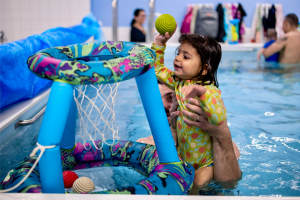
The learning process is aided with games and fun
What “Learning to Swim” Means for Babies
When we talk about babies “learning to swim,” we don’t mean swimming laps or freestyle strokes. For infants and toddlers (ages 6 months to 4 years), swimming is about building water comfort and safety, including:
- Feeling relaxed and happy in the water
- Holding their breath underwater
- Gliding and kicking for a few seconds
- Reaching for the wall or a parent for safety
These early skills form the foundation for strong swimming later in childhood.
Typical Learning Timeline
Every baby is different, but here’s what many families experience in our Infant-Toddler Swim Program at Chicago Blue Dolphins:
| Time in Lessons | Typical Progress |
|---|---|
| 1–2 Months | Getting comfortable in the water and with the class routine, smiling, splashing, parent-guided entries and exits, building to a coach-guided gentle, “no tears” submersion. |
| 2–4 Months | Gliding with breath-holding (2–3 seconds), child-driven entries and exits. |
| 4–6 Months | Gliding with kicks (2-3 seconds), entries to a short swim, glide to the wall and independent exit. |
| 6–12 Months | Safety swim (enter, turn around, return and exit), longer glides with kicks (up to 7 seconds), longer parent-guided swims to the wall, standing jump and entries |
| 12-24 Months | Front and back floats, flips from front to back, simple swim strokes on the front and back, retrieving toys underwater, and other skills to prepare for independent class at 4. |
Some babies move faster. Others take their time. What matters most is that learning happens through joy, not pressure.
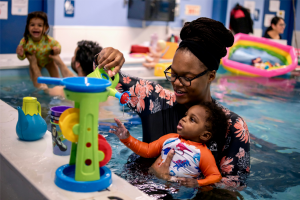
Getting the little ones playing with water is a key first step to baby swimming.
What Affects How Fast a Baby Learns?
Four key factors influence progress:
1. Age When They Start
Babies who begin lessons around 6–12 months often adapt more quickly to water than older toddlers who may show more fear or hesitation. On the other hand, older toddlers will have the strength and coordination for kicking, wall walking, and climbing out of the water.
2. Frequency of Classes
Once-a-week lessons are great. Twice-a-week lessons help skills stick faster and allow babies to build muscle memory more quickly.
3. Comfort and Confidence
A relaxed baby learns best. That’s why we:
✔ Use warm-water pools
✔ Keep class sizes small (5:1 max)
✔ Use songs, toys, and games instead of forcing skills
4. Consistency Over Time
Stopping lessons for months at a time can slow progress. Just like learning a language or playing an instrument, swimming is better learned through steady, joyful repetition.
Why Patience Is Part of the Process
Swimming isn’t a race—it’s a relationship with the water.
The goal isn’t to make babies independent swimmers overnight. It’s to build trust, safety, happiness, and readiness for more advanced skills in the preschool years.
A child who learns to love the water will learn to swim.
So… How Long Does It Take?
With weekly lessons, many babies are displaying basic swimming skills within 3–6 months and strong water confidence within 6–12 months.
But most importantly:
👉 Every class is progress.
👉 Every splash counts.
👉 Every smile in the pool is part of the journey.
Ready to Start Your Baby’s Swim Journey?
Our Infant-Toddler Swim Program helps babies as young as 6 months become comfortable, confident, and safe in the water—at their own pace, with you by their side.